Digestion, intensity, and end time: how to work out in the evening without ruining your sleep
Working late? Small kids you rightly want time with? Night shifts? Whatever the reason you prefer — or have — to train after dinner, we've got you covered.
A few compact numbers to start: after a full meal you need 2–3 hours to digest; after a light snack 30–60 minutes is enough. If you start before digestion is done, waiting stretches because the harder you go, the more the stomach slows. And there's a second constraint people talk about less: for sleep, when you finish matters more than when you start.
Below: timing tables, what changes with what's on your plate, what to do with only an hour, and recent numbers on sleep if you finish late.
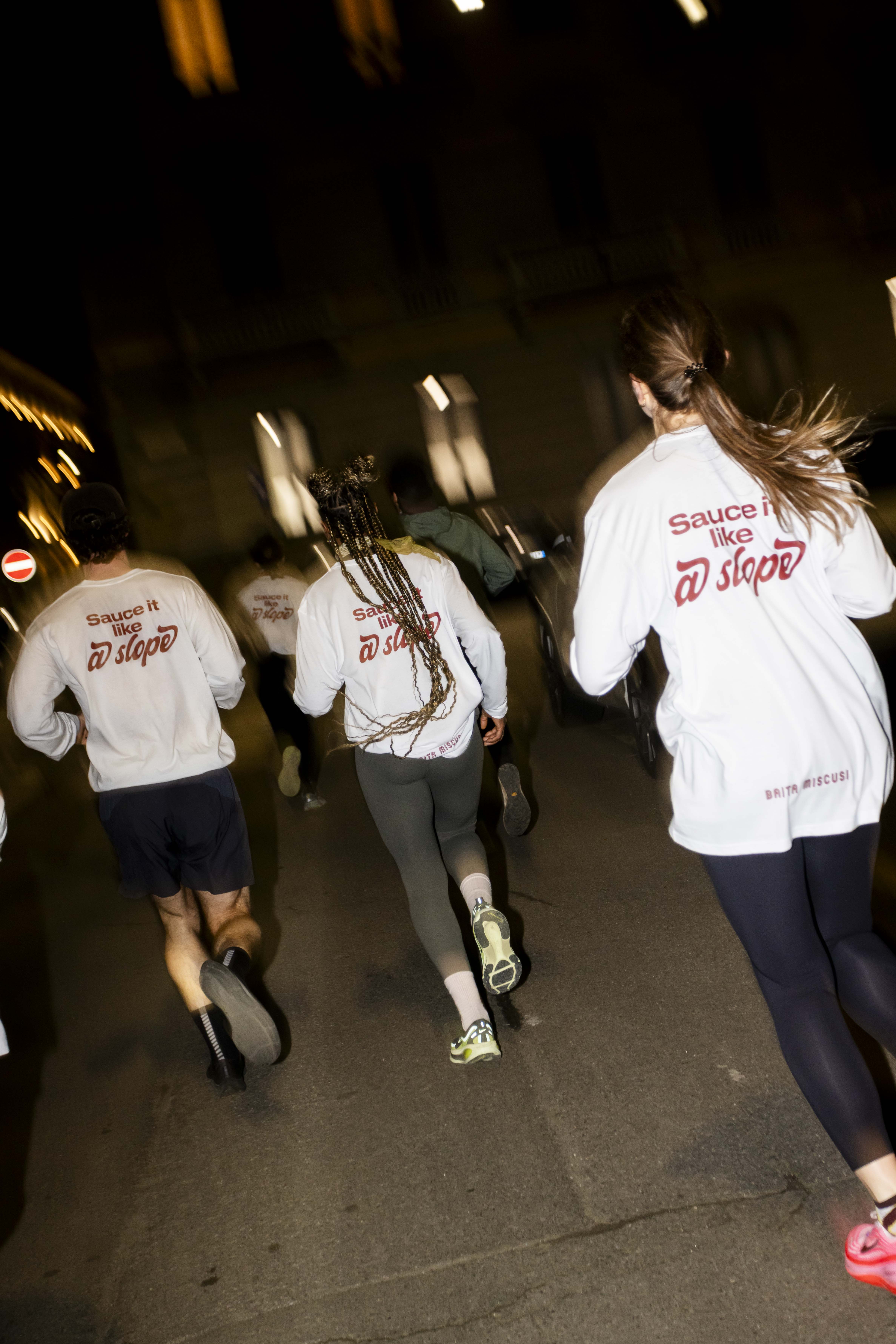
Glycogen doesn't watch the clock. The dinner before the session is the fuel that session will use.
How long to wait after dinner before training
As above: two to three hours after a full meal. It's the only Italian institutional guidance on the topic.
CREA's healthy-eating guidelines (Italy's Ministry of Agriculture research centre) say the last full meal before sport should be at least 2–3 hours earlier, not huge, rich in complex carbs and low in insoluble fibre. In the last half hour only a lightly sugared drink remains — ideally 6–8% concentration (yes, you won't check that, but we had to say it) CREA 2018 [1].
In clock times, with dinner at 20:00:
| What you ate | When you can start | What the session can handle |
| Full dinner with starter, main and veg | 22:00–23:00 | Anything |
| Single carb plate with little fat | 21:30–22:00 | Easy run, gym |
| Light snack, bread and jam or fruit | 20:30–21:00 | Up to an hour, moderate |
| Sugary drink only | 20:15 | Short session |
The number to remember isn't three hours — it's plate composition: a light dinner 90 minutes out causes fewer issues than a fatty dinner three hours out.
Why does your stomach slow down when you train while still full?
Because effort intensity interferes with gastric emptying — how fast the stomach hands food to the gut.
Horner et al.'s 2015 Sports Medicine meta-analysis (20 studies, 35 trials, 221 participants) finds a modest average effect of exercise on emptying, but a clear intensity link: "at lower intensities gastric emptying is faster, at higher intensities it is slower" Horner 2015 [2]. Walking speeds it up; cycling slows it.
Two recent papers put numbers under that sentence. Nomura et al. (European Journal of Applied Physiology, 2025) measured emptying after an hour of running and found about 38 minutes under normal conditions Nomura 2025 [3]. Yamaguchi et al. (Physical Activity and Nutrition, 2026) showed repeated sprints slow gastric emptying versus rest, in proportion to power output Yamaguchi 2026 [4].
The practical point: the same dinner you digest fine while walking sits heavier if you do intervals. Short on time? Lower intensity instead of skipping dinner.
What changes depending on what's on your plate
Fat and fibre lengthen the wait. Simple carbs and lean protein shorten it.
de Oliveira, Burini and Jeukendrup's 2014 Sports Medicine review on exercise gut issues recommends avoiding fibre-rich foods in the hours before effort and notes that people unused to eating before moving have twice the risk of gut symptoms de Oliveira 2014 [5].
For the dinner before an evening session:
| 1. works well: pasta with a simple sauce, rice, potatoes, white bread, lean protein, ripe fruit |
| 2. lengthens the wait: fried food, fatty sauces, aged cheeses, fatty meats, very large portions |
| 3. save for after: whole legumes, lots of raw veg, large wholegrain portions — great foods, just not in the hour before you head out |
It's about timing more than food bans: the same foods that slow a 20:00 dinner are perfect at 22:30.
If you only have an hour: the snack that works
When sixty minutes remain between office and training, the choice isn't dinner vs no dinner.
With an hour of margin, a snack of about 1 gram of carbs per kg of body weight works — roughly 60–80 g for most people: white bread and jam, two rice cakes with honey, a ripe banana, a juice. Low fibre, low fat, nothing new you haven't tried. Real dinner comes when you get home.
Same logic as any-hour pre-workout meal, covered in sports nutrition and what to eat before the gym. What doesn't work is the third way — heading out empty because it's late: numbers on that choice are in training fasted.
Does training in the evening hurt sleep?
It depends how hard you go and how late you finish — and the numbers only arrived recently.
The largest study on the topic is Leota et al., Nature Communications 2025: 14,689 active people across over four million nights from wearables. Versus a light session, a maximal session ending two hours before usual bedtime delays sleep onset by 36 minutes and shortens sleep by 5.4% (22 minutes); if it ends two hours after usual sleep onset, bedtime shifts by 80 minutes and sleep shortens by 13.9% (43 minutes). Night heart rate rises up to 9.4 bpm; heart-rate variability falls. Authors recommend finishing hard effort at least four hours before sleep Leota 2025 [6].
The picture is gradual: effect grows with session intensity and how late you finish. A post-dinner walk leaves sleep where it was; intervals at eleven move it. Practical reckoning:
| If the session is | Finish by | Why |
| Light or moderate (walk, easy run, technique) | 1 hour before bed | Study comparison baseline: sleep effect stays negligible |
| Hard (full gym, tempo, group class) | 2 hours before | Need time for heart rate to come down |
| Maximal (race, intervals, HIIT) | 4 hours before | Below that threshold sleep onset shifts measurably |
Better to eat before or after evening training?
Both work. What changes is what's on the plate.
If you eat before, everything above applies: digestible meal, carbs as base, fat and fibre contained, about two hours of margin. If you eat after, dinner becomes the recovery meal and can be complete. CREA guidelines want it "restoring", without fatty hard-to-digest foods — with a reason that fits anyone training at night: "sleep is crucial for an athlete" CREA 2018 [1].
On protein there's a finding that fits late trainers. Trommelen and van Loon (Nutrients, 2016) show at least 40 g of protein before sleep robustly stimulates overnight muscle protein synthesis, stronger after resistance training Trommelen 2016 [7]. Forty grams is a full-meal amount — a normal dinner with good protein gets there without supplements. On the hours after effort see what to eat after the gym.
If after dinner you get heartburn, regurgitation or pain when you move, shifting dinner time won't fix it — talk to a doctor.
Carbs in the evening: the false problem
People who train after dinner often arrive with a belief that makes everything harder: that evening pasta should be avoided.
Nothing in physiology makes a carb different at 20:00 vs 13:00. What counts is the day's total relative to how much you move — and for evening trainers that total is high by definition. Covered in does pasta make you gain weight and pasta on a diet; on cooking and sauce effects on glycaemic response see pasta glycaemic index.
Train in the evening and skip carbs at dinner, and you train worse the next day.
Why a plate of pasta is the right dinner before an evening session
Re-read the pre-workout dinner checklist: lots of carbs, little fat, little insoluble fibre, digestible, easy to quantify. That's a plate of pasta.
The practical edge an improvised dinner lacks: pasta can be weighed. You know how many grams of carbs are on the plate — the only way to dose dinner for the session instead of guessing. A miscusi spaghetti plate has 86 g of carbs (miscusi data [8]), a base that holds about ninety minutes of evening work. If the same plate also needs recovery protein, semolina with legumes has over 17 g per serving (miscusi data [8]).
Ours is Superpasta: fresh, egg-free, just water and organic semolinas of durum Kronos and stone-milled ancient grains like Perciasacchi, bronze-drawn. On fibre, the timing rule above applies: higher-fibre shapes suit the post-session dinner better than the one an hour before you train.
Ready for your pre-workout dinner?
You came for how long to wait after dinner — the honest answer is that two or three hours are a solid reference, while what really moves the needle is what's on the plate and how hard you go.
The rest is logistics. Evening trainers don't have a timing problem — they have a rushed-dinner problem.
With us you build the pre-session dinner as you need: pick a dish from the menu or go make your own — shape, sauce and protein one by one — so fat stays low when you're heading out and fibre sits where it belongs when you're coming back.
Our Power of Carbs ambassadors know late sessions well. Book a table at the nearest miscusi: we handle dinner, you handle when you leave home.
Quick answers (FAQ)
How long should you wait after dinner before training?
Two to three hours after a full meal, according to CREA guidelines, with a meal that isn't huge, rich in complex carbs and low in insoluble fibre. After a light snack, 30–60 minutes is enough. Waiting stretches if dinner is fatty or heavy and if the session is intense.
Can you run right after dinner?
Better not after a full meal: running intensity slows gastric emptying and gut symptom risk rises. With a light dinner and easy running, about an hour is reasonable; for intervals or tempo you need the full two or three hours.
Does evening training hurt sleep?
It depends on intensity and when you finish. In Leota et al. 2025 on nearly 15,000 active people, a maximal session ending after usual bedtime delayed sleep onset by 80 minutes and shortened sleep by 13.9%; versus a light session the gap shrinks until it becomes negligible.
What time should you stop training in the evening?
It depends on intensity: a light session can finish one hour before bed, a hard one two hours before, a maximal one at least four hours before — the threshold from the 2025 wearable-data study authors.
What to eat before evening training if you're short on time?
A snack of about 1 g of carbs per kg of body weight — roughly 60–80 g for most people: white bread and jam, rice cakes with honey, a ripe banana or a juice. Low fibre, low fat, nothing new. Full dinner comes after you get home.
Is it better to eat before or after evening training?
Both work. If you eat before, keep the meal digestible and about two hours away; if you eat after, dinner becomes the recovery meal and can be complete, while avoiding fatty foods that disturb sleep.
How much protein do you need in the post-evening-training dinner?
Trommelen and van Loon (Nutrients, 2016) point to at least 40 g of protein before sleep to stimulate overnight muscle protein synthesis, with a stronger effect after resistance training. That's a full-meal amount.
Do evening carbs make you gain weight if you train afterwards?
No. What matters is the day's total relative to how much you move, more than when carbs arrive. For evening trainers, a carb dinner fuels the session and overnight recovery.
Sources
| 1. CREA, Linee guida per una sana alimentazione, revisione 2018, capitolo sull'alimentazione dello sportivo. Pagina ufficiale crea.gov.it e testo integrale PDF |
| 2. Horner KM, Schubert MM, Desbrow B, Byrne NM, King NA, Acute Exercise and Gastric Emptying: A Meta-Analysis and Implications for Appetite Control, Sports Medicine, 2015. Springer |
| 3. Nomura S, Sumi D, Nagatsuka H, Suzuki T, Goto K, Effects of endurance exercise under hypoxic conditions on the gastric emptying rate and intestinal cell damage, European Journal of Applied Physiology, 2025. doi |
| 4. Yamaguchi K, Sumi D, Hayashi N, Goto K, Repeated-sprint exercise delays gastric emptying independently of hypoxia and heat exposure, Physical Activity and Nutrition, 2026. doi |
| 5. de Oliveira EP, Burini RC, Jeukendrup A, Gastrointestinal Complaints During Exercise, Sports Medicine, 2014. PMC |
| 6. Leota J, Presby DM, Le F et al., Dose-response relationship between evening exercise and sleep, Nature Communications, 2025. Nature |
| 7. Trommelen J, van Loon LJC, Pre-Sleep Protein Ingestion to Improve the Skeletal Muscle Adaptive Response to Exercise Training, Nutrients, 2016. MDPI |
| 8. miscusi, analisi nutrizionale interna del menu, 2026 |