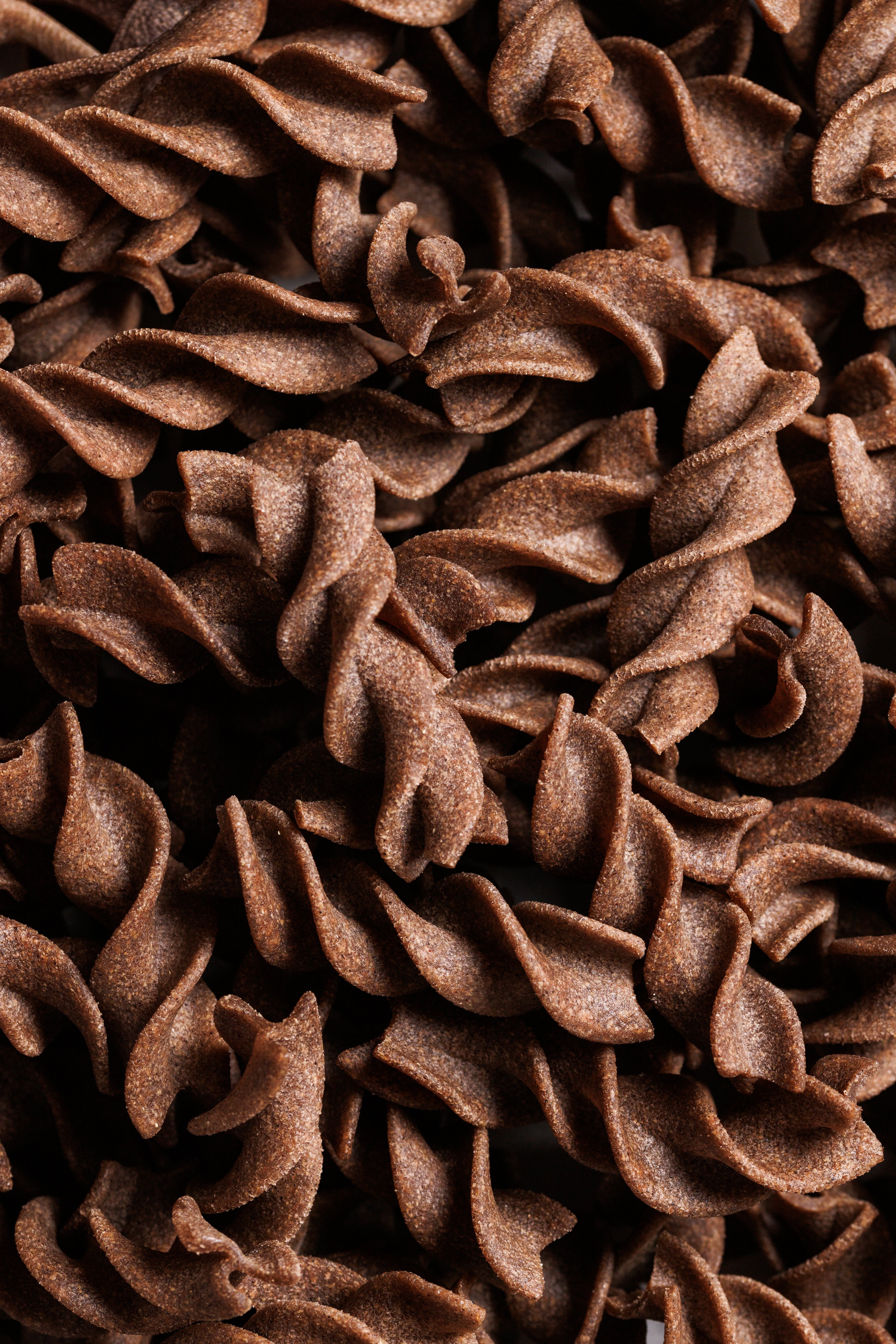
Keto pasta, Cochrane, and why losing a kilogram in two years isn't a revolution
Whenever the market invents a pasta that isn't pasta, we read the label. Habit worth copying.
Commercial keto pastas exist and keep the technical promise: very few carbs, because they're made of isolated proteins, fibres and konjac — not wheat. The point is elsewhere. The strongest systematic reviews say cutting carbs doesn't produce meaningful weight loss: at one–two years the gap vs a balanced diet is about a kilo. Performance pays: in elite athletes on minimal carbs, the drop is measurable. Spelt and lentil pasta hide two different myths — we unpack both with label numbers.
Four things left to clear: what's inside keto pasta, what the meta-analyses say, why the scale drops in week one, and what changes when you swap in spelt or legumes.
We've got nothing against people who count carbs. We've got something against selling carbophobia as an ingredient.
What a ketogenic diet is — and why pasta doesn't fit
Ketogenic diets keep carbs under 50 g/day (some versions 20 g) with fat at 70–80% of calories. Ketosis usually starts after 3–4 days of glycogen depletion (Harvard [1]).
Pasta maths is immediate: 100 g dry semolina pasta has 72.7 g available carbs (CREA) (CREA [2]); an 80 g portion ≈ 58 g.
Fifty-eight grams: one plate already blows the daily keto cap. Not moderation — arithmetic incompatibility. Hence the market for “pasta” that isn't pasta.
Italy's ISS frames keto as a strongly hypocaloric clinical tool with defined indications (severe obesity, T2D, hypertension, drug-resistant epilepsy) and risks (micronutrient/fibre shortfalls, glycogen depletion, ketoacidosis risk, renal load) (ISS [3]). Contraindications include liver/kidney/heart failure, type 1 diabetes, pregnancy and breastfeeding.
Keto is a clinical tool with a clear perimeter — not a lifestyle because a colleague does it. Talk to a doctor first.What ketogenic pasta is actually made of
Flip the pack. Typical keto pasta: isolated soy/pea protein, egg white powder, wheat/bamboo fibre, inulin, psyllium, corn flour — 9.8 g carbs, 34 g fibre, 41 g protein, 298 kcal/100 g (Cardo Keto [4]).
Konjac/shirataki: water, konjac flour, calcium hydroxide — 7.6 kcal/100 g (shirataki [5]) because it's already hydrated.
EU-authorised glucomannan claim: contributes to weight loss in a hypocaloric diet at 3 g/day in three doses with water before meals (EU claims [6]). Choking warning required.
Honest caveats: shirataki labels rarely state glucomannan per serving; Onakpoya 2014 meta-analysis of 8 RCTs found 0.22 kg vs placebo (CI includes zero) (Onakpoya 2014 [7]).
If that's the lever, it's a short one.Does cutting carbs make you lose weight?
Less than marketing claims. Twin question on pasta itself: does pasta make you gain weight?.
Cochrane 2022 (Naudé et al.): 61 RCTs, 6,925 participants — low-carb vs balanced diets:
| Population & duration | Weight difference favouring low-carb |
|---|---|
| No diabetes, 3–8.5 months | 1.07 kg |
| No diabetes, 1–2 years | 0.93 kg |
| Type 2 diabetes, 3–6 months | 1.26 kg |
| Type 2 diabetes, 1–2 years | 0.33 kg |
None clinically meaningful; authors: little or no difference up to two years.
About a kilo in two years.DIETFITS (609 adults, 12 months): low-fat −5.3 kg vs low-carb −6.0 kg (ns). Low-carb group still ate 132 g carbs/day at 12 months (Gardner 2018 [9]).
ARIC cohort (15,428 adults, 25 years): U-shaped carbs–mortality association; lowest risk at 50–55% energy (Seidelmann 2018 [10]). Observational — associations, not proof.
Why the scale drops in the first week anyway
True: cutting carbs drops the scale fast in the first days — but what are you losing?
Each gram of glycogen is stored with at least 3 g water (Kreitzman 1992 [11]). Empty ~500 g muscle + 100 g liver glycogen and the water goes too — a couple of kilos, not fat.
First pasta dinner brings it back. You didn't fail — you refilled a tank. More: what carbs are for.
What happens to performance if you train without carbs
Skip if you don't train. If you train, this is the key section.
Elite race walkers, 25 days intensified training, one arm <50 g carbs/day: oxygen cost at race pace +7.1% (20 km); 10,000 m performance −2.3% while high-carb groups improved (Burke 2020 [12]).
Anaerobic meta-analysis (Nutrients 2026): single short efforts mostly intact; repeated sprint ability modestly worse (Nutrients 2026 [13]).
Gym angle: gym nutrition. Adherence falls over time; early “keto flu” is common (Bostock 2020 [14]).
Does spelt pasta make you gain weight?
No — and it doesn't slim you either. Label vs label:
| Per 100 g | Emmer spelt pasta | Semolina pasta |
|---|---|---|
| Energy | 358 kcal | 359 kcal |
| Carbs | 70 g | 71 g |
| Protein | 13 g | 13 g |
| Fibre | 3.2 g | 3.0 g |
| Fat | 2.2 g | 2.0 g |
One calorie difference — within label tolerance. Choose spelt for taste/variety, not to lighten the plate. Calories deep-dive: how many calories in pasta.
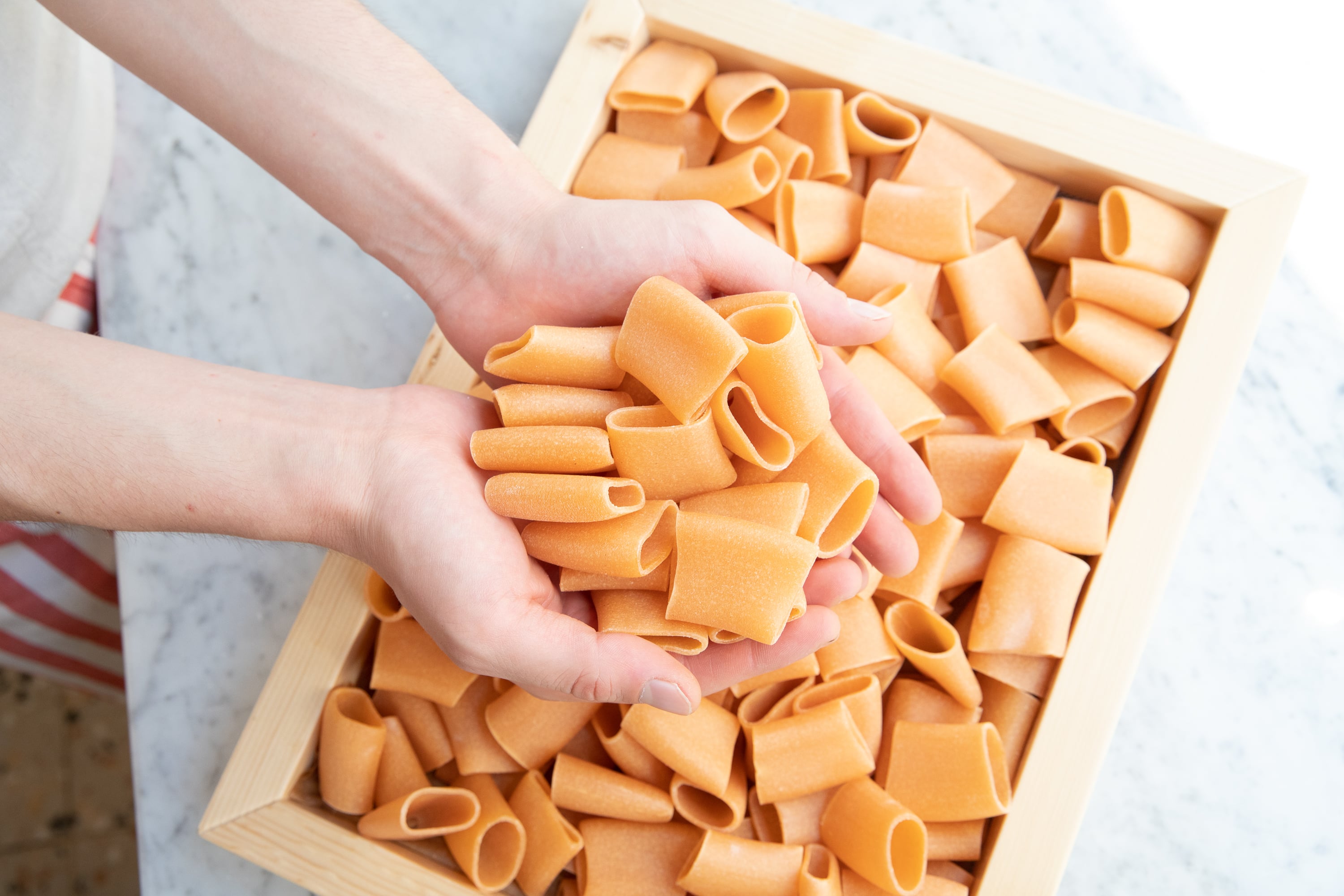
Does lentil pasta make you gain weight?
Not either — here the swap has a real point, just not the calorie myth:
| Per 100 g | Red lentil pasta | Chickpea pasta | Semolina |
|---|---|---|---|
| Energy | 334 kcal | 348 kcal | 359 kcal |
| Carbs | 50 g | 45.1 g | 71 g |
| Protein | 26 g | 21 g | 13 g |
| Fibre | 7.6 g | 14 g | 3.0 g |
Calories: only 3–7% lower. Real shift: carbs down, protein up, fibre up. Mean GI for legume pastas ~46 vs 55 wheat (Foods 2021 [19]). More: pasta glycaemic index.
At miscusi, legume pasta exists — and doesn't pretend to be something else
Bottom line: cutting carbs saves ~1 kg in two years, costs performance if you train, and almost nobody sticks to it. Legume pasta makes sense because it adds protein and fibre.
Ours is Superpasta: fresh, egg-free, organic Kronos durum + stone-milled ancient grains (Perciasacchi), bronze-drawn — plus organic sorghum and legume blends. Sorghum is naturally gluten-free but cooked in the same kettles as wheat pasta — not for coeliacs.
Build your plate from the menu or make your own. Quantity guide: pasta on a diet.
FUCK "CHEAT" MEALS. Pasta is not a sin to forgive. Book a table.Quick answers (FAQ)
Does ketogenic pasta exist?
Products sold as such exist — isolated soy/pea proteins, plant fibres, inulin, psyllium, or konjac and water. They meet the carb constraint (~10 g/100 g or near zero) but are different foods, not lighter pasta.
How many carbs does pasta have — why incompatible with keto?
100 g dry semolina pasta has 72.7 g available carbs; an 80 g portion ≈ 58 g. Keto stays under 50 g/day — one plate already exceeds the daily cap.
Does cutting carbs make you lose weight?
Much less than claimed. Cochrane (61 RCTs, 6,925 people): ~1 kg difference at 1–2 years without diabetes; 0.33 kg with T2D. Authors: little or no difference.
Why do you drop ~2 kg in the first carb-free days?
Each gram of glycogen stores with ≥3 g water. Emptying ~500 g muscle + 100 g liver glycogen loses water too — scale drops without fat loss; weight returns when carbs return.
Does keto worsen sports performance?
Very short efforts: mostly no. Intense repeated efforts: yes — elite walkers <50 g carbs/day: +7.1% oxygen cost, −2.3% on 10,000 m. Elite data — transfer with caution.
Does spelt pasta make you gain weight?
No — and it doesn't slim you: 358 vs 359 kcal/100 g, macros nearly identical. Choose for taste/variety, not to lighten the plate.
Does lentil pasta make you gain weight?
No — calories only 3–7% lower. Real change: carbs ~50 vs 71 g, protein 26 vs 13 g, fibre 7.6 vs 3 g; mean GI ~46 vs 55.
Does glucomannan cause weight loss?
EU-authorised claim with 3 g/day in three pre-meal doses in a hypocaloric diet. Meta-analysis of 8 RCTs: no significant loss vs placebo (mean 0.22 kg).
Sources
| 1. Harvard T.H. Chan School of Public Health, The Nutrition Source, Diet Review: Ketogenic Diet for Weight Loss. https://nutritionsource.hsph.harvard.edu/healthy-weight/diet-reviews/ketogenic-diet/ |
| 2. CREA, Tabelle di composizione degli alimenti, pasta di semola. https://www.alimentinutrizione.it/tabelle-nutrizionali/000800 |
| 3. Istituto Superiore di Sanità, ISSalute, Dieta iperproteica e chetogenica. https://www.issalute.it/index.php/la-salute-dalla-a-alla-z-menu/d/dieta-iperproteica-e-chetogenica |
| 4. Cardo Keto, etichetta nutrizionale della pasta chetogenica. https://www.cardoketo.it/prodotto/pasta-ketogenica-senza-glutine/ |
| 5. Mifan, etichetta nutrizionale degli spaghetti shirataki di konjac. https://www.mifan.it/prodotti-di-konjac/shirataki-konjac-spaghetti-250g |
| 6. Commissione europea, registro delle indicazioni nutrizionali e sulla salute. https://ec.europa.eu/food/food-feed-portal/backend/claims/files/euregister.pdf |
| 7. Onakpoya I et al., The efficacy of glucomannan supplementation in overweight and obesity, J Am Coll Nutr, 2014, scheda DARE. https://www.ncbi.nlm.nih.gov/books/NBK195354/ |
| 8. Naudé CE et al., Low-carbohydrate versus balanced-carbohydrate diets, Cochrane Database of Systematic Reviews, 2022. https://www.cochrane.org/evidence/CD013334_low-carbohydrate-diets-or-balanced-carbohydrate-diets-which-works-better-weight-loss-and-heart |
| 9. Gardner CD et al., Effect of Low-Fat vs Low-Carbohydrate Diet on 12-Month Weight Loss, JAMA, 2018. https://jamanetwork.com/journals/jama/fullarticle/2673150 |
| 10. Seidelmann SB et al., Dietary carbohydrate intake and mortality, The Lancet Public Health, 2018. https://utsouthwestern.elsevierpure.com/en/publications/dietary-carbohydrate-intake-and-mortality-a-prospective-cohort-st/ |
| 11. Kreitzman SN, Coxon AY, Szaz KF, Glycogen storage: illusions of easy weight loss, Am J Clin Nutr, 1992. https://eurekamag.com/research/002/120/002120137.php |
| 12. Burke LM et al., Ketogenic low-carbohydrate high-fat diet impairs exercise economy and performance in elite race walkers, PLoS ONE, 2020. https://journals.plos.org/plosone/article?id=10.1371%2Fjournal.pone.0234027 |
| 13. Gawelczyk W, Chycki J, Maszczyk A, Zając A, Effects of the ketogenic diet on anaerobic performance, Nutrients, 2026. https://www.mdpi.com/2072-6643/18/10/1589 |
| 14. Bostock ECS, Kirkby KC, Taylor BV, Hawrelak JA, Consumer Reports of "Keto Flu", Frontiers in Nutrition, 2020. https://www.frontiersin.org/journals/nutrition/articles/10.3389/fnut.2020.00020/pdf |
| 15. Sgambaro, etichetta nutrizionale degli spaghetti biologici di farro dicocco. https://shop.sgambaro.it/products/spaghetti-bio-farro-dicocco |
| 16. Barilla, etichetta nutrizionale degli spaghetti n. 5. https://www.carrefour.it/p/barilla-pasta-spaghetti-n.5-500g/8076800195057.html |
| 17. Felicia, etichetta nutrizionale degli spaghettoni di lenticchie rosse. https://felicia.com/it/shop/spaghettoni-di-lenticchie-rosse |
| 18. Barilla, etichetta nutrizionale delle casarecce di ceci. https://www.carrefour.it/p/barilla-pasta-ai-legumi-casarecce-di-ceci-100-farina-di-legumi-250g/8076809575157.html |
| 19. Di Pede G et al., Glycemic Index Values of Pasta Products: An Overview, Foods, 2021. https://www.mdpi.com/2304-8158/10/11/2541 |