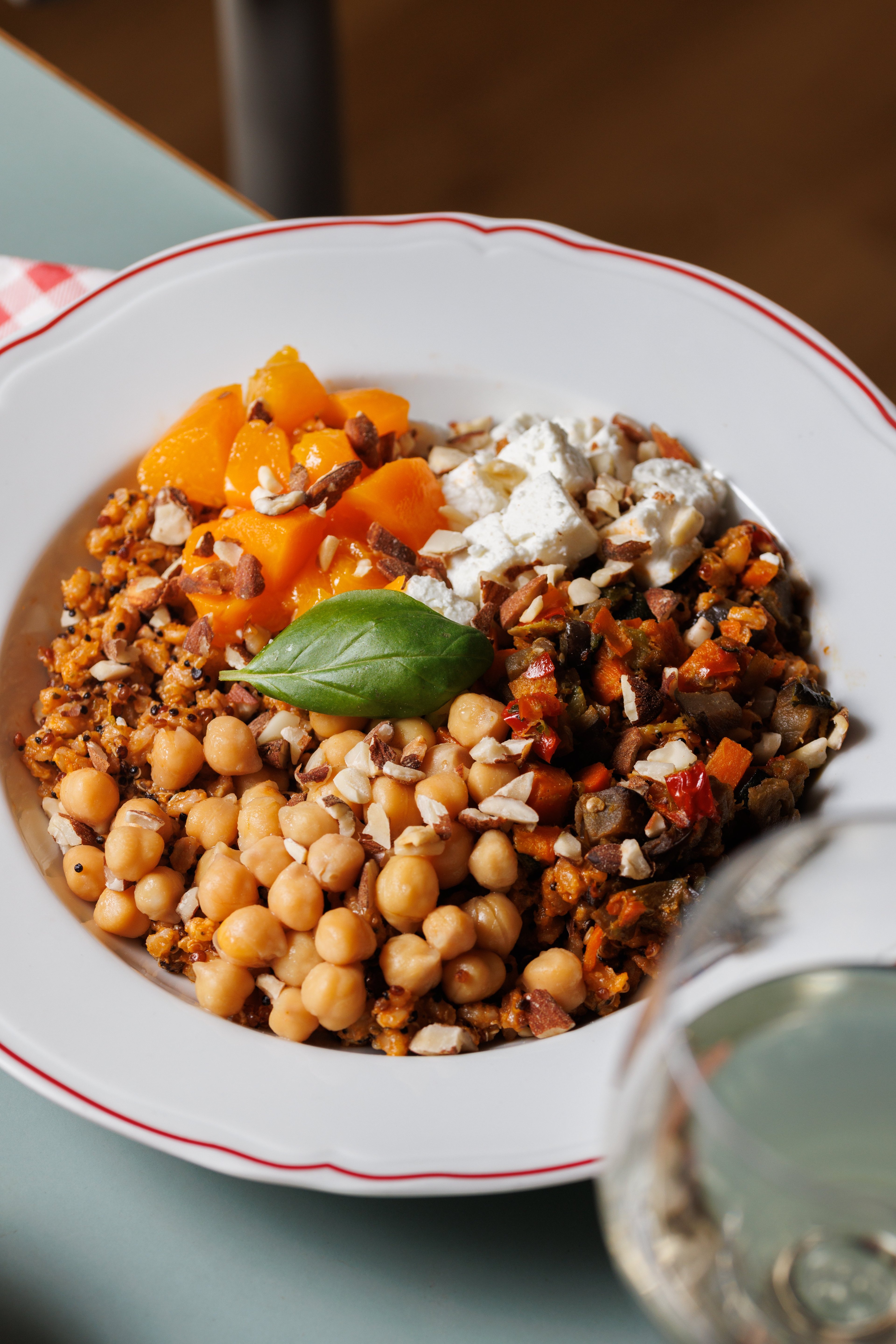
Quinoa, No Myths
At miscusi we live on pasta and we do not hide it. In our kitchen, though, there is room for quinoa too. If we put an ingredient on the plate, we want to know it well, including its real strengths.
Quinoa is the seed of an Andean plant, Chenopodium quinoa, used in cooking like a cereal. According to CREA tables, the research centre of the Italian Ministry of Agriculture, 100 grams of raw quinoa contain 15.4 grams of protein, 57.8 grams of available carbohydrates, the ones the body can digest, and 12.2 grams of fibre, with good amounts of magnesium, potassium and iron CREA [1]. Its proteins contain all essential amino acids, the ones the body cannot produce on its own. Clinical studies show small effects on cholesterol and blood glucose and no proven slimming effect. The cautions concern few people: those who have had oxalate kidney stones, those whose gut is not used to fibre and, in restaurant dishes, people with coeliac disease. The bitter taste of saponins is removed by rinsing it.
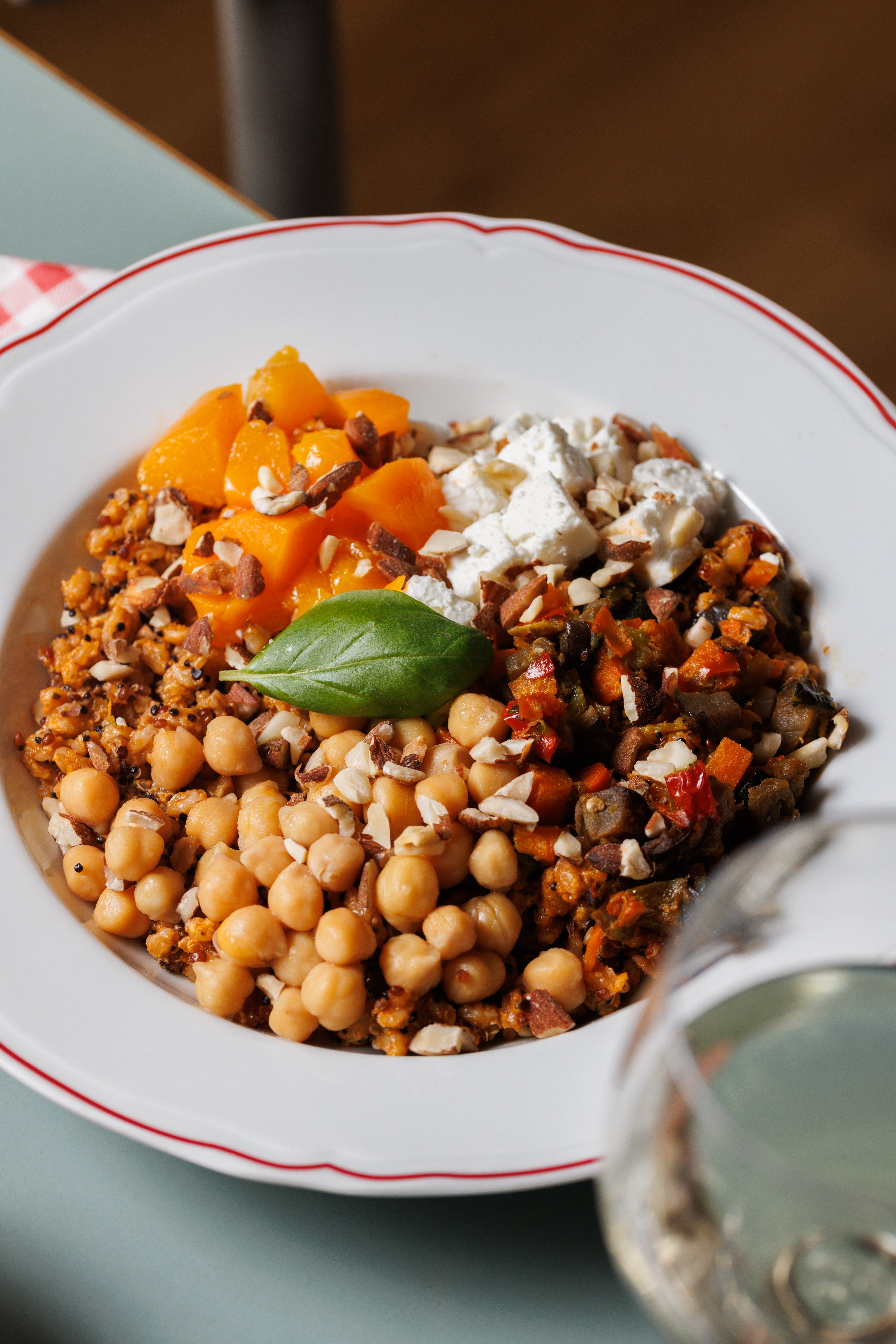
Quinoa has millennia of Andes behind it and just over ten years as a social media star. Fame came with the latter, its properties with the former.
What quinoa is: a seed that acts like a cereal
It is a pseudocereal: a seed that behaves like a cereal in the kitchen, even though it comes from a different plant family.
The plant belongs to the Amaranthaceae family, the same as spinach and beetroot, while wheat and rice are grasses. Vega-Gálvez and colleagues, in a 2010 review in the Journal of the Science of Food and Agriculture, note that it has been cultivated along the Andes for about 7,000 years, from Bolivia at 4,500 metres above sea level to the coasts of Chile Vega-Gálvez 2010 [2]. Its fame in Europe is much more recent. The UN General Assembly declared 2013 the International Year of Quinoa, in honour of the Andean peoples who had grown it for centuries UN 2013 [3]. From then on, the little seed started appearing in every lunch-break salad.
One fun detail: it has more relatives in the vegetable garden than in the granary. In the kitchen it behaves like a cereal, in the garden it is a cousin of chard, so its properties should be read for what it is.
What quinoa contains: nutritional values
It contains mainly carbohydrates, with a good share of protein and fibre and an interesting dose of minerals.
The CREA table values are these CREA [1] CREA [4]:
| Per 100 g | Raw quinoa | Cooked quinoa, boiled and drained |
| Energy | 376 kcal | 140 kcal |
| Available carbohydrates | 57.8 g | 24.3 g |
| of which starch | 47.7 g | 19.3 g |
| Protein | 15.4 g | 4.8 g |
| Fat | 8.1 g | 2.5 g |
| Fibre | 12.2 g | 3.6 g |
| Potassium | 655 mg | 175 mg |
| Magnesium | 189 mg | 61 mg |
| Iron | 3.6 mg | 1.1 mg |
The figures show that in the pot quinoa more than doubles in weight because it absorbs water: that is why the cooked values are lower. CREA’s reference portion is 80 grams of raw quinoa: around 46 grams of carbohydrates, 12 of protein and almost 10 of fibre in one plate. In a salad, it already does half the work almost without trying.
For a seed cooked like a cereal, quinoa also contains some fat, about 8 grams per 100 grams raw. It is still little: in an 80 gram raw portion, that is about 6 and a half grams.
Quinoa protein: truly complete
Yes: quinoa contains all nine essential amino acids, the ones we must get from food.
Harvard University’s Nutrition Source defines it as a complete protein Harvard [5]. The detail nutritionists like is lysine, an amino acid quinoa proteins are especially rich in, as summarised by Dakhili and colleagues in Food Chemistry in 2019 Dakhili 2019 [6].
Fifteen grams of protein per 100 grams raw is a good contribution. Quinoa helps build a protein-rich meal: in a quinoa salad, it makes sense to add legumes, eggs, cheese or fish, just as you would with any other cereal.
White, red and black quinoa: properties compared
What changes most is colour and the amount of antioxidants. For the rest, they are very similar.
The colour of red and black quinoa comes from betacyanins, the same pigments found in beetroot. Tang and colleagues, in Food Chemistry in 2015, measured that darker seeds contain more polyphenols, plant substances with antioxidant activity, and have higher antioxidant power in the lab Tang 2015 [7]. On the main nutrients, however, Pereira and colleagues found only small differences between the three colours, limited to a few parameters Pereira 2019 [8].
In practice, red and black quinoa stay firmer when cooked and taste a little stronger, while white quinoa is softer and works almost anywhere. Choose the one you like best, or the one that photographs better: nutritionally, the differences are too small to make it a health issue.
Puffed quinoa: do the properties change?
Protein changes little, while for glycaemic index, meaning how much a food raises blood glucose, data are missing.
Puffed quinoa is made by heating the seed under pressure until the water inside turns into steam and expands it, like puffed rice in breakfast cereals. Zapana and colleagues compared pressure puffing, extrusion and microwaves in 2020: with the first two methods, protein remains between 11 and 13 grams per 100 grams of dry product and is preserved better than with microwaves Zapana 2020 [9].
What we did not find is a measured glycaemic index for puffed quinoa: it is not in databases or published studies. We explain glycaemic index in the article on glycaemic index and glycaemic load. For boiled quinoa, however, the value exists and is around 50 Sydney GI [10]. On puffed quinoa, anyone giving you a precise number has made it up.
What quinoa is good for, according to studies
It is good in the way a fibre- and nutrient-rich food is good within a varied diet. The effects measured in clinical studies are small, and there are none on weight.
The most recent synthesis is by Atefi and colleagues, published in Current Medicinal Chemistry in 2024. They collected seven randomised studies, for a total of 258 adults who ate 15 to 50 grams a day for four weeks to six months. Weight and body mass index did not change. A modest effect appeared on fasting blood glucose, more evident around 25 grams per day Atefi 2024 [11]. The studies are few and small, so the picture may still change.
An earlier meta-analysis by Karimian and colleagues in Phytotherapy Research in 2021 found weight loss of just over one kilo and small reductions in triglycerides and cholesterol Karimian 2021 [12]. Taken together, the two analyses suggest choosing quinoa for what it brings to the plate, complete protein and fibre, while ignoring weight-loss promises.
On this, studies agree with us: we have been dealing with carbophobia for years. No food makes you lose weight on its own, not even if it comes from the Andes with a valid passport. Weight depends on how much you eat and how much you move: the same reasoning we use in the article on whether pasta makes you gain weight.
Quinoa: contraindications and side effects
For most people there are no contraindications. The cautions concern a few specific cases.
Bitter taste and saponins: saponins are bitter substances that coat the seed and protect it from birds and insects. They are removed by washing, still the most common method in industry too El Hazzam 2020 [13]. Packaged quinoa is usually already washed, as Harvard’s Nutrition Source notes; rinsing it under running water before cooking removes any remaining bitterness.
Oxalates and kidney stones: plants from the quinoa family are among the foods richest in oxalates, substances that can form calcium oxalate stones Siener 2006 [14]. Anyone who has already had this type of stone should speak to a doctor before making quinoa a daily habit.
Fibre: with more than 12 grams of fibre per 100 grams raw, people who are not used to it may feel bloated if they eat a lot at once. Increasing quantities gradually is enough.
Gluten and coeliac disease: quinoa is naturally gluten-free. In the lab, two varieties out of fifteen activated an immune response in cells from people with coeliac disease Zevallos 2012 [15], while 19 coeliac people who ate 50 grams a day for six weeks did not worsen Zevallos 2014 [16].
In our restaurants, however, quinoa is prepared in the same kitchen and with the same tools as wheat pasta, so it may come into contact with gluten: for this reason our dishes are not suitable for people with coeliac disease.
At miscusi, quinoa is on the plate and pasta stays at the centre
You came here to learn about quinoa’s properties, and the answer is more concrete than Instagram promises: a nutritious seed, with complete proteins and plenty of fibre, that fits well into a varied meal. The same, to be honest, is true of a good plate of pasta. We do say that as an interested party.
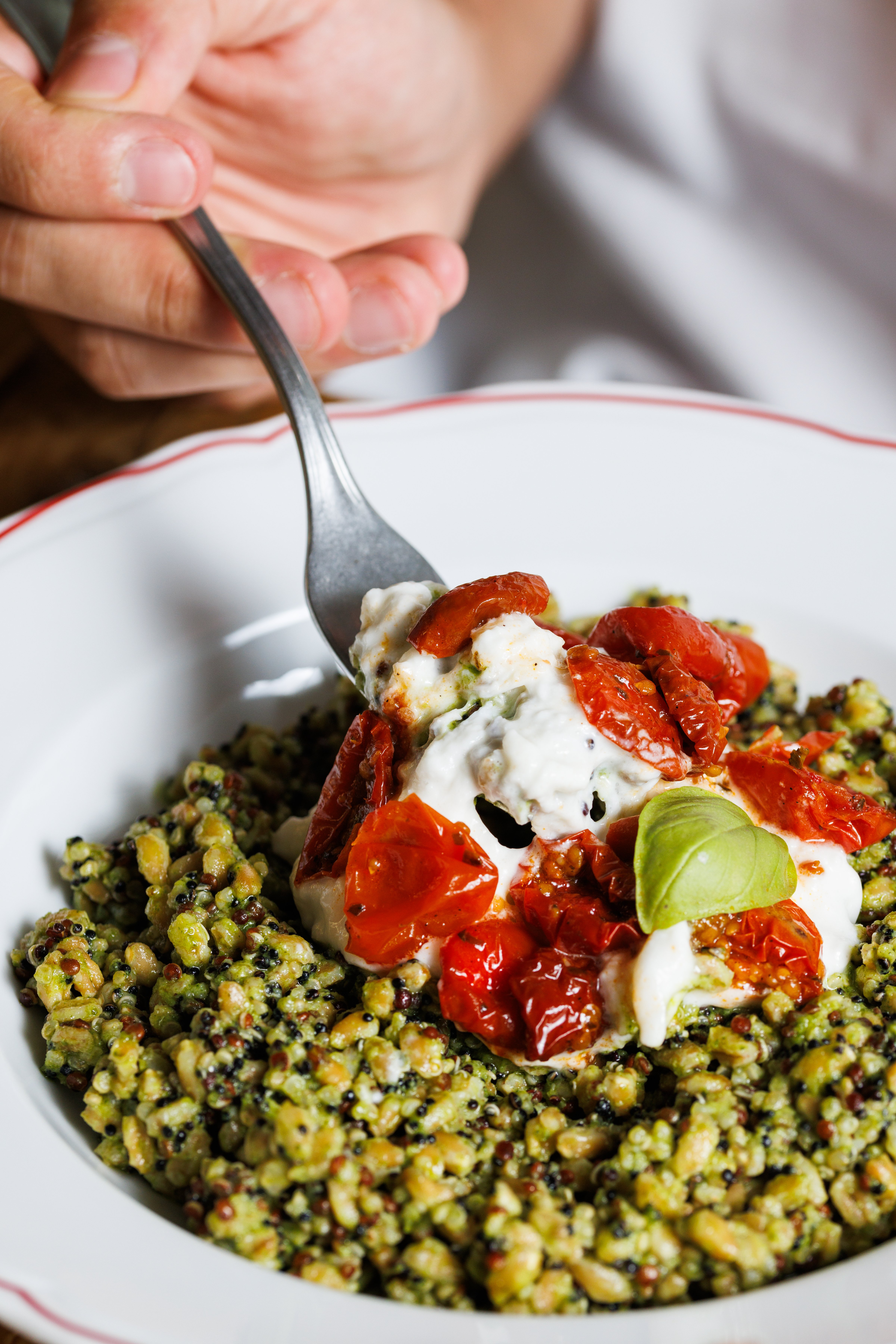
At miscusi you find quinoa in Riviera, a mix of spelt and quinoa with Genoese pesto, Apulian stracciatella and confit tomatoes. Alongside it there is our Superpasta, fresh and made with water and organic semolina: Kronos durum wheat and stone-milled ancient grains such as Perciasacchi.
Choose a dish from the menu or create your own make your own, building the plate you need, whether you follow a precise diet or just the hunger of the moment. At miscusi almost anyone can eat, even those who only wanted a salad and go home with a plate of pasta. Book your table.
Quick answers (FAQ)
Does quinoa make you gain weight?
No, no food makes you gain weight on its own. According to CREA, 100 grams of cooked quinoa have 140 calories, in line with other cooked cereals. What matters is the overall amount you eat during the day.
How much quinoa can you eat per day?
CREA’s reference portion is 80 grams of raw quinoa. In clinical studies, people ate up to 50 grams a day for months without problems. It can be eaten every day within a varied diet, unless your doctor says otherwise.
Should quinoa be washed before cooking?
It is worth rinsing it under running water. Packaged quinoa is usually already washed; rinsing still removes any remaining saponins, the substances that give it a bitter taste.
Is quinoa a cereal or a legume?
It is a pseudocereal, the seed of a plant from the Amaranthaceae family, related to spinach and beetroot, used in cooking like a cereal.
Does quinoa raise blood sugar?
Boiled quinoa has a glycaemic index around 50, so medium-low. Like any carbohydrate-rich food, it raises blood glucose and the effect depends on quantity and what is on the plate with it.
Which quinoa is healthiest, white, red or black?
They are broadly equivalent. Red and black have a few more antioxidants because of their pigments, but nutritional differences are small. The choice is mostly about taste and texture.
Sources
| 1. CREA, Centro di ricerca Alimenti e Nutrizione, Tabelle di composizione degli alimenti, voce 000096 quinoa cruda. https://www.alimentinutrizione.it/tabelle-nutrizionali/000096 |
| 2. Vega-Gálvez A, Miranda M, Vergara J et al., Nutrition facts and functional potential of quinoa (Chenopodium quinoa Willd.), an ancient Andean grain: a review, Journal of the Science of Food and Agriculture, 2010. https://doi.org/10.1002/jsfa.4158 |
| 3. UN News, Quinoa Year aims to ease food insecurity and transform the global diet, 2013. https://news.un.org/en/story/2013/02/432392 |
| 4. CREA, Centro di ricerca Alimenti e Nutrizione, Tabelle di composizione degli alimenti, voce 000097 quinoa cotta. https://www.alimentinutrizione.it/tabelle-nutrizionali/000097 |
| 5. Harvard T.H. Chan School of Public Health, The Nutrition Source, Quinoa, 2024. https://nutritionsource.hsph.harvard.edu/food-features/quinoa/ |
| 6. Dakhili S et al., Quinoa protein: composition, structure and functional properties, Food Chemistry, 2019. https://europepmc.org/article/MED/31323439 |
| 7. Tang Y et al., Characterisation of phenolics, betanins and antioxidant activities in seeds of three Chenopodium quinoa Willd. genotypes, Food Chemistry, 2015. https://doi.org/10.1016/j.foodchem.2014.06.018 |
| 8. Pereira E et al., Chemical and nutritional characterization of Chenopodium quinoa Willd grains, Food Chemistry, 2019. https://europepmc.org/article/MED/30642475 |
| 9. Zapana F et al., Physical, chemical and nutritional characteristics of puffed quinoa, International Journal of Food Science and Technology, 2020. https://academic.oup.com/ijfst/article/55/1/313/7806116 |
| 10. University of Sydney, Glycemic Index Research Service, GI Database, voce quinoa. https://glycemicindex.com/gi-search/?food_name=quinoa |
| 11. Atefi M et al., Does quinoa consumption improve blood glucose, body weight and body mass index?, Current Medicinal Chemistry, 2024. https://europepmc.org/article/MED/36847233 |
| 12. Karimian J et al., The effects of quinoa seed supplementation on cardiovascular risk factors, Phytotherapy Research, 2021. https://europepmc.org/article/MED/33037704 |
| 13. El Hazzam K et al., An insight into saponins from quinoa: a review, Molecules, 2020. https://europepmc.org/article/MED/32120971 |
| 14. Siener R et al., Oxalate contents of species of the Polygonaceae, Amaranthaceae and Chenopodiaceae families, Food Chemistry, 2006. https://doi.org/10.1016/j.foodchem.2005.05.059 |
| 15. Zevallos VF et al., Variable activation of immune response by quinoa prolamins in celiac disease, American Journal of Clinical Nutrition, 2012. https://europepmc.org/article/MED/22760575 |
| 16. Zevallos VF et al., Gastrointestinal effects of eating quinoa in celiac patients, American Journal of Gastroenterology, 2014. https://europepmc.org/article/MED/24445568 |