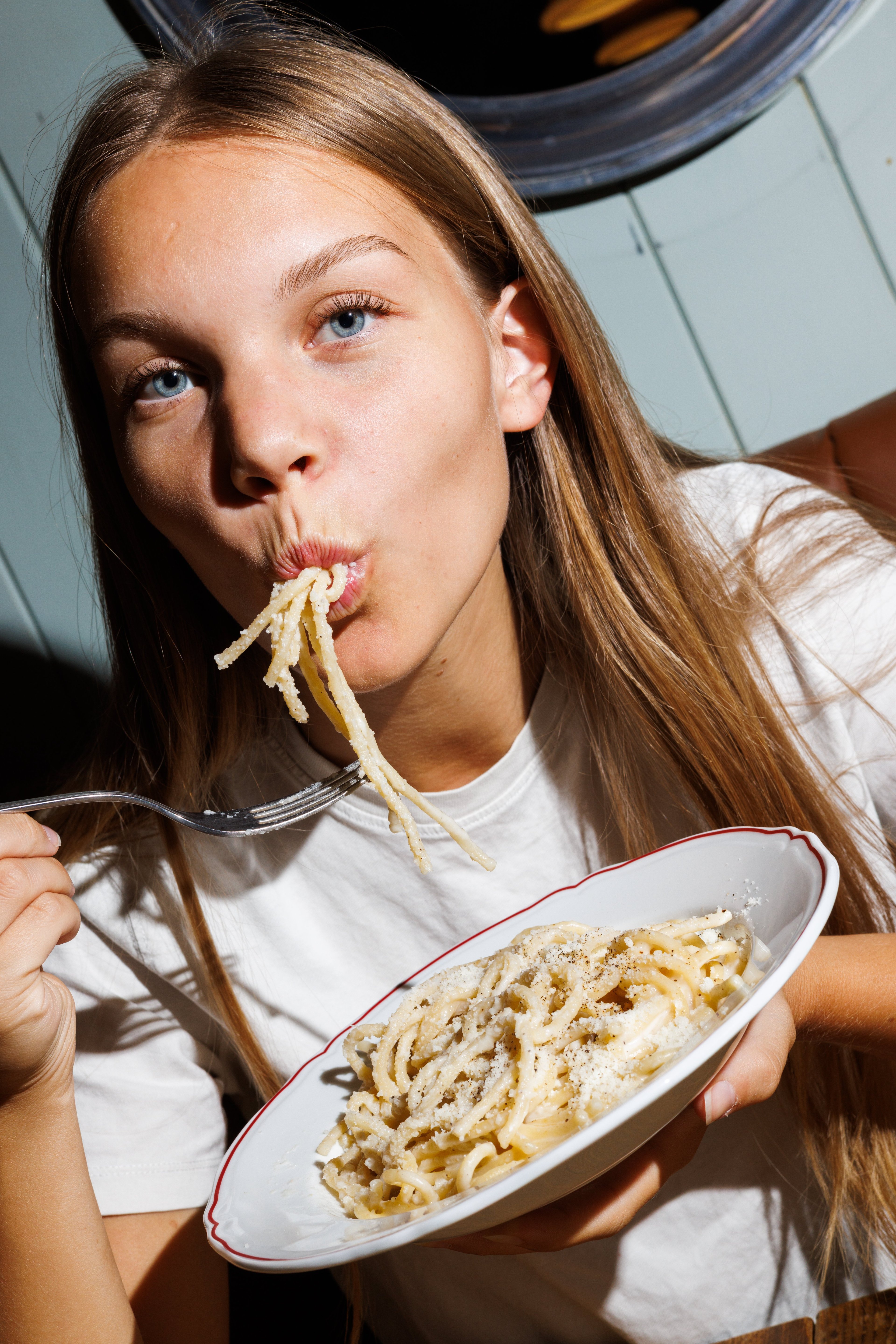
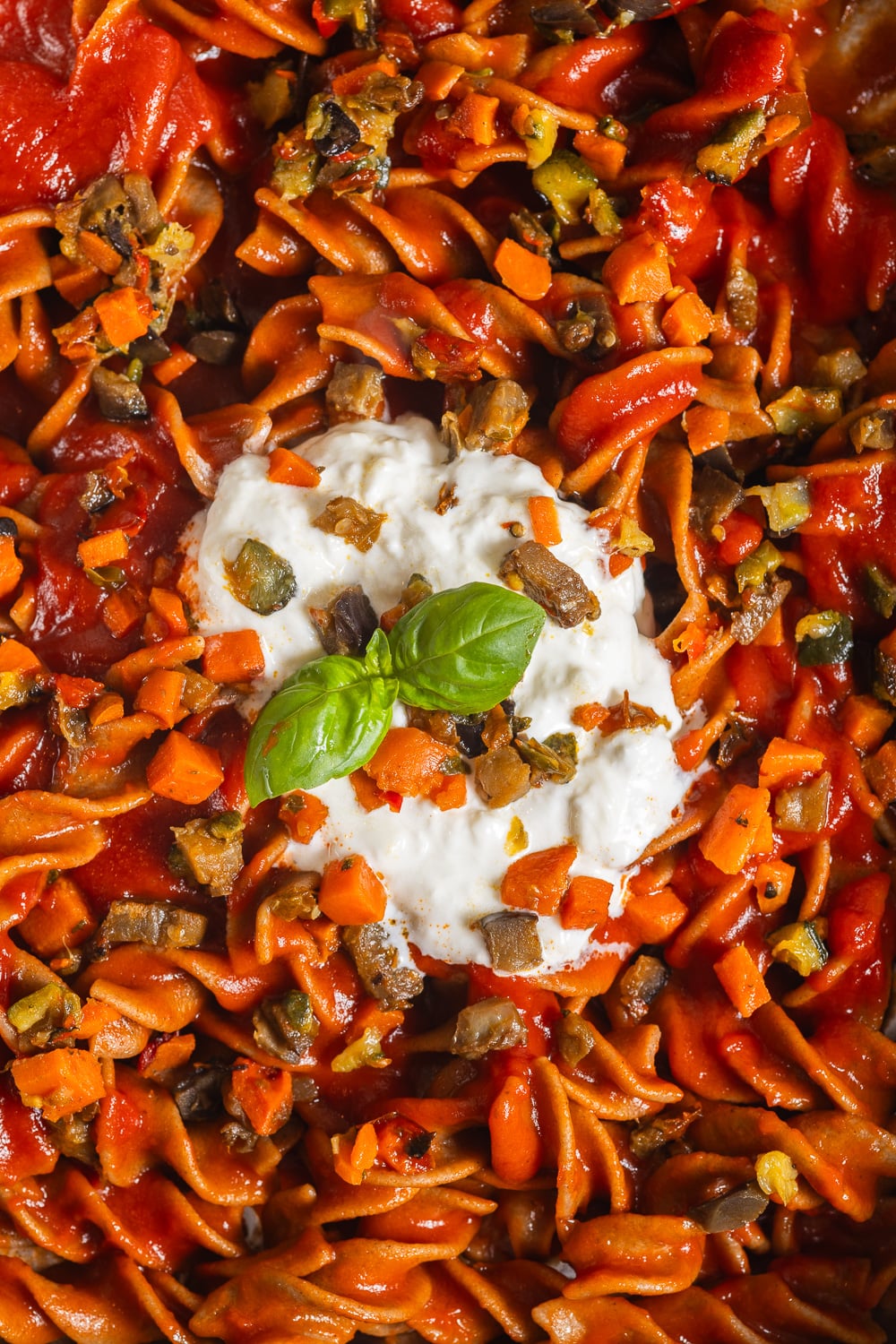
The full plate does the maths — not the pasta alone.
Pasta calories per 100 grams: official values
| Alimento | Energia | Proteine | Grassi | Carboidrati | Fibra |
|---|---|---|---|---|---|
| Pasta di semola, cruda | 341 kcal | 13,5 g | 1,2 g | 72,7 g | 1,7 g |
| Pasta di semola, cotta | 175 kcal | 6,9 g | 0,6 g | 37,3 g | 0,9 g |
| Pasta integrale, cruda | 330 kcal | 13,3 g | 2,2 g | 64,8 g | 7,1 g |
| Pasta integrale, cotta | 182 kcal | 7,4 g | 1,2 g | 36,0 g | 3,5 g |
| Pasta all'uovo secca, cruda | 346 kcal | 13,0 g | 2,4 g | 71,0 g | 3,2 g |
| Pasta all'uovo secca, cotta | 123 kcal | 4,6 g | 0,8 g | 25,5 g | 1,1 g |
| Ravioli freschi, crudi | 265 kcal | 10,6 g | 7,3 g | 40,7 g | 2,2 g |
| Tortellini freschi, crudi | 302 kcal | 12,2 g | 7,1 g | 49,9 g | 1,2 g |
| Gnocchi di patate, crudi | 164 kcal | 3,9 g | 0,3 g | 37,9 g | 1,9 g |
Why the pack shows one number and tables another
The real mistake: mixing up dry and cooked
| Alimento | Peso dopo la cottura, partendo da 100 g crudi |
|---|---|
| Pasta di semola corta | 188 g |
| Pasta di semola lunga | 210 g |
| Pasta all'uovo secca | 299 g |
| Ravioli freschi | 140 g |
| Gnocchi di patate | 106 g |
Portion calories — what you actually need
| Porzione | Energia |
|---|---|
| 80 g di pasta di semola cruda | 273 kcal |
| 80 g di pasta integrale cruda | 264 kcal |
| 125 g di ravioli freschi | 331 kcal |
| 150 g di gnocchi di patate crudi | 246 kcal |
Calories of the finished plate, not just the pasta
| Piatto (porzione CREA) | Energia per porzione |
|---|---|
| Gnocchi al sugo di pomodoro | 302 kcal |
| Pasta al sugo di pomodoro | 316 kcal |
| Pasta burro e parmigiano | 331 kcal |
| Pasta cacio e pepe | 334 kcal |
| Pasta integrale al pomodoro | 351 kcal |
| Pasta aglio, olio e peperoncino | 361 kcal |
| Pasta alle vongole | 393 kcal |
| Pasta al pesto alla genovese | 420 kcal |
| Lasagna | 470 kcal |
| Pasta al ragù alla bolognese | 554 kcal |
| Pasta alla carbonara | 563 kcal |
| Pasta all'amatriciana | 650 kcal |
Low-calorie pasta: does it really exist?
At miscusi we count substance, not only calories
Quick answers (FAQ)
How many calories are in 100 g of pasta?
100 g of dry durum semolina pasta is 341 kcal according to CREA tables. The same pasta cooked is 175 kcal per 100 g, because it absorbs water and almost doubles in weight.
How many kcal in 100 g of cooked pasta?
About 175 kcal for durum pasta, 182 for wholewheat and 123 for dry egg pasta, which triples its weight when cooked. Values are lower than dry only because absorbed water dilutes energy — calories aren't lost.
How many calories in 80 grams of pasta?
About 273 kcal for durum and 264 for wholewheat, on dry weight. 80 g is the Italian standard portion (LARN) and corresponds to roughly 150–155 g cooked.
Why does every site give a different calorie number for pasta?
Because calculation methods differ. CREA uses 3.75 kcal per gram of carbs; EU labelling uses 4 kcal per gram; some sources still cite the old INRAN table. Coefficients change, not the grams.
Which pasta has the fewest calories?
Among dry pastas the gap is tiny: 330 kcal for wholewheat to 346 for egg pasta. Look at fibre instead: wholewheat has 7.1 g/100 g vs 1.7 g refined and fills you longer at the same energy.
How many calories in a plate of pasta with tomato sauce?
About 316 kcal per portion in CREA weighed recipes based on 80 g dry pasta each. With the same pasta, carbonara hits 563 kcal and amatriciana 650: the topping makes the difference.
Sources
| 1. CREA, Tabelle di composizione degli alimenti, pasta e derivati — alimentinutrizione.it |
| 2. CREA, Presentazione dati (cottura e coefficienti) — alimentinutrizione.it |
| 3. CREA, Ricette italiane pesate — PC0016 |
| 4. SINU, LARN standard quantitativi delle porzioni, 2014 — sinu.it |
| 5. Regolamento (UE) n. 1169/2011, Allegati XIII e XIV — eur-lex |
| 6. AIRC, Un piatto colmo di cibo sano — airc.it |
| 7. miscusi, analisi nutrizionale interna del menu, 2026 |