Glycogen, LARN, EU claims, and why simple vs. complex isn't enough anymore
Carbs are the fuel; glycogen is the tank. Three non-interchangeable jobs: muscle fuel at intensity, sole energy for brain/red blood cells, and raw material for ~500 g muscle + 100 g liver glycogen.

Carbs = Energy. Glycogen is the tank — the right question isn't whether to fill it, but when.
What carbs do in the body
Glucose is non-negotiable for brain, red blood cells and exercising muscle. ~100 g/day for the adult brain alone (IOM); ISS: main energy source at 4 kcal/g.
How many carbs you need per day
EFSA/LARN: 45–60% of daily energy; minimum 2 g/kg to avoid ketosis (140 g for 70 kg). CREA 2023: Italians at 42% — below recommendation.
Muscle glycogen: what it is and how much you carry
~500 g muscle + ~100 g liver glycogen. Each gram stores with ≥3 g water — rapid scale drop on low-carb, not fat loss.
How long glycogen lasts when you move
At 75% VO₂max for 60 min: −50–70% glycogen. One 30 s sprint: −22%. Weights: −24–40%. Marathon wall ~km 34 — carbs yield more kcal per litre O₂ than fat.
How to refill the tank after training
ACSM: 1–1.2 g/kg/h carbs for 4–6 h post-exercise. Delaying 2 h cuts resynthesis rate by >⅓. Full restore: 24 h, 6–12 g/kg.
The EU health claim few people know
EU authorised claim: carbs contribute to restoring normal muscle function after intense/long exercise depleting glycogen. Conditions: 4 g/kg within 4–6 h (280 g for 70 kg).
Simple vs complex carbs: why it's not enough anymore
FAO/WHO: use chemical names (sugars, oligosaccharides, polysaccharides). 'Simple vs complex' can't predict nutritional effect — white bread (complex) spikes more than an apple.

"Slow-release carbs": do they really exist?
No institutional 'slow-release carb' definition; slowly digestible starch = digested in 20–120 min. Shape matters — pasta qualifies, same-flour bread doesn't.
Resistant starch: the carb you don't digest
Resistant starch (RS1–RS5) behaves like fibre. RS3 forms on cooling cooked foods — why fridge pasta differs. Fibre target: ≥25 g/day (LARN).
Why a plate of pasta is the simplest way to fill the tank
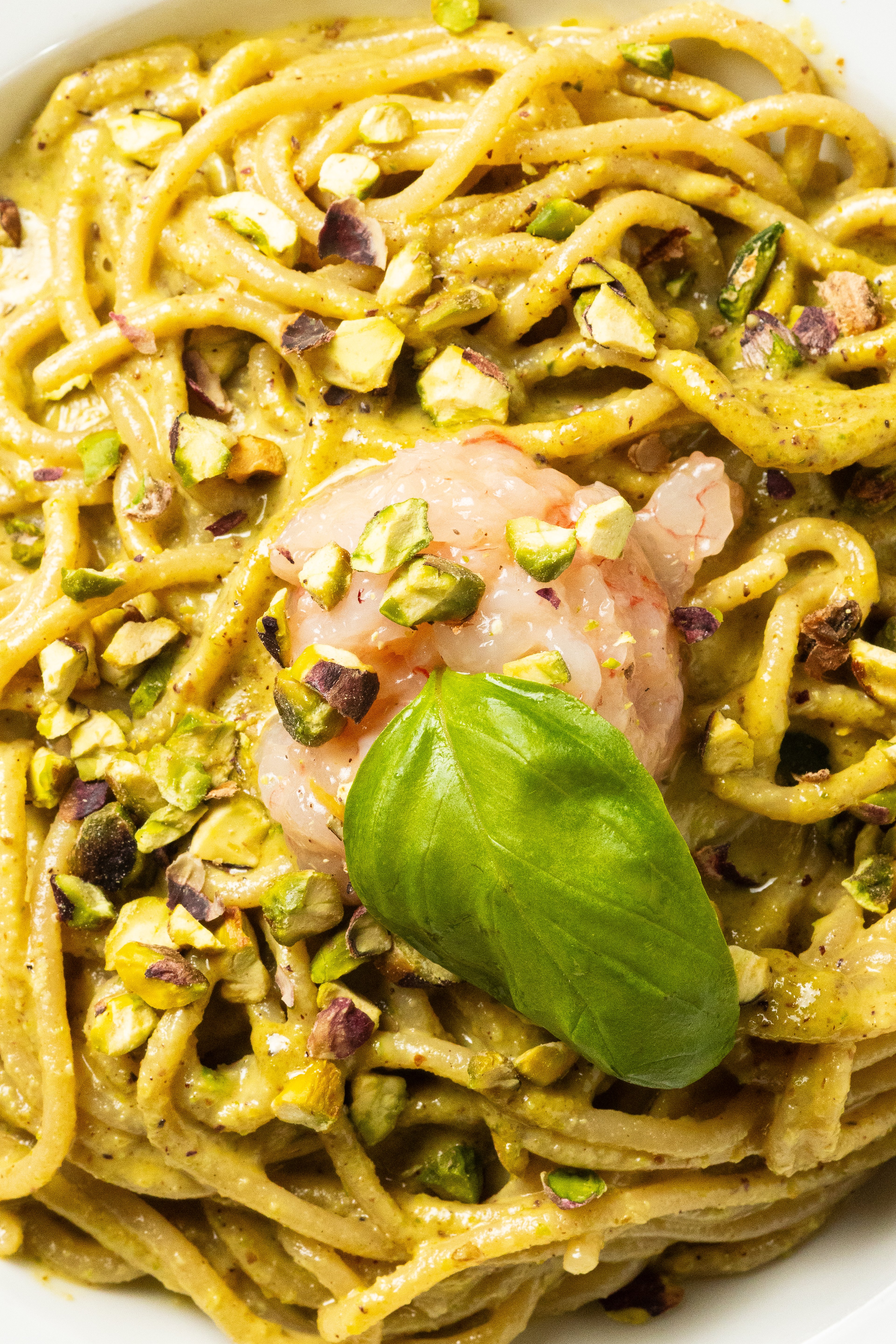
One miscusi spaghetti plate: 86 g carbs (~1.2 g/kg for 70 kg) — a solid chunk of the 2 g/kg LARN minimum. Legume semolina adds protein.
At miscusi, carbs aren't a sin to confess
Superpasta: organic Kronos + ancient grains + legume blends. Eat carbs, feel good. Menu or make your own. Power of Carbs ambassadors. Book a table.
Quick answers (FAQ)
What are carbs for?
Three things: muscle fuel when intensity rises; sole usable energy for brain and red blood cells; raw material for glycogen (~500 g muscle, 100 g liver).
How many carbs per day?
45–60% of energy (EFSA/LARN); minimum 2 g/kg to avoid ketosis (140 g for 70 kg). Italians average 42% — below recommendation.
What is muscle glycogen?
Branch-chained glucose storage in muscle (~500 g adult). Muscle can't share it — private fuel. Liver glycogen (~100 g) stabilises blood sugar.
How long does muscle glycogen last?
−50–70% after 60 min at 75% VO₂max. −22% from one 30 s sprint. −24–40% in a weights session. Marathon bonk ~km 34.
Why rapid weight loss cutting carbs?
Each glycogen gram stores with ≥3 g water. Empty the tank, lose water — scale drops, fat doesn't. Weight returns with carbs.
Simple vs complex carbs?
Simple = 1–2 sugar units; complex = 10+. FAO/WHO: classification can't predict effect — white bread (complex) spikes more than an apple.
Do slow-release carbs exist?
No institutional definition; slowly digestible starch (20–120 min digestion) is measurable. Shape and food matrix matter, not the label.
What is resistant starch?
Starch reaching the colon like fibre. Five types including RS3 from cooling cooked food — why fridge pasta behaves differently.
Sources
| 1. Chourpiliadis C, Mohiuddin SS, Biochemistry, Gluconeogenesis, StatPearls, 2023. https://www.ncbi.nlm.nih.gov/books/NBK544346/ |
| 2. Institute of Medicine, razioni raccomandate di carboidrati, NCBI Bookshelf. https://www.ncbi.nlm.nih.gov/books/NBK618346/ |
| 3. Istituto Superiore di Sanità, ISSalute, Carboidrati. https://www.issalute.it/index.php/la-salute-dalla-a-alla-z-menu/c/carboidrati |
| 4. EFSA NDA Panel, Dietary Reference Values for carbohydrates and dietary fibre, 2010. https://www.efsa.europa.eu/en/efsajournal/pub/1462 |
| 5. SINU, LARN per carboidrati e fibra alimentare. https://sinut.it/2019/07/09/carboidrati-e-fibra-alimentare/ |
| 6. CREA, indagine nazionale sui consumi alimentari, 2023. https://www.crea.gov.it/documents/20126/0/CREA_+cs+VI+Nutrinformarsi_+15+novembre+2023.pdf |
| 7. Jensen J et al., The role of skeletal muscle glycogen breakdown, Front Physiol, 2011. https://pure-oai.bham.ac.uk/ws/files/48973139/fphys_02_00112.pdf |
| 8. Rapoport BI, Metabolic Factors Limiting Performance in Marathon Runners, PLoS Comput Biol, 2010. https://journals.plos.org/ploscompbiol/article?id=10.1371%2Fjournal.pcbi.1000960 |
| 9. Fernández-Elías VE et al., Relationship between muscle water and glycogen recovery, Eur J Appl Physiol, 2015. https://link.springer.com/article/10.1007/s00421-015-3175-z |
| 10. Mata F et al., Carbohydrate Availability and Physical Performance, Nutrients, 2019. https://www.mdpi.com/2072-6643/11/5/1084 |
| 11. Thomas DT et al., Nutrition and Athletic Performance, ACSM position stand, 2016. https://www.dietitians.ca/DietitiansOfCanada/media/Documents/Resources/noap-position-paper.pdf |
| 12. Alghannam AF et al., Restoration of Muscle Glycogen and Functional Capacity, Nutrients, 2018. https://www.mdpi.com/2072-6643/10/2/253 |
| 13. Regolamento (UE) 2015/7. https://eur-lex.europa.eu/legal-content/IT/TXT/?uri=CELEX:32015R0007 |
| 14. EFSA NDA Panel, parere su carboidrati e recupero funzione muscolare, 2013. https://www.efsa.europa.eu/en/efsajournal/pub/3409 |
| 15. FAO/WHO, Carbohydrates in Human Nutrition. https://www.fao.org/4/w8079e/w8079e07.htm |
| 16. Cummings JH, Stephen AM, Carbohydrate terminology and classification, Eur J Clin Nutr, 2007. https://www.nature.com/articles/1602936 |
| 17. Linus Pauling Institute, Glycemic Index and Glycemic Load. https://lpi.oregonstate.edu/mic/food-beverages/glycemic-index-glycemic-load |
| 18. Pu H et al., Slowly digestible starch, Springer, 2018. https://link.springer.com/chapter/10.1007/978-981-13-1077-5_2 |
| 19. Baptista NT et al., Harnessing the power of resistant starch, Front Nutr, 2024. https://www.frontiersin.org/journals/nutrition/articles/10.3389/fnut.2024.1369950/full |
| 20. Stephen AM et al., Dietary fibre in Europe, Nutr Res Rev, 2017. https://www.cambridge.org/core/journals/nutrition-research-reviews/article/dietary-fibre-in-europe-current-state-of-knowledge-on-definitions-sources-recommendations-intakes-and-relationships-to-health/B263D1D7B3440DC9D6F68E23C2B4212F |
| 21. miscusi, analisi nutrizionale interna del menu, 2026. |